Thank you for your patience and understanding. I am now posting the report, but please note that I have excluded parts that refer to staffing and other non-aviation related items.
Anyway, enjoy and I'm sorry of it is a little long!!
Before posting the majority of the report from Chris Woodroofe I thought that I would add a few additional comments that he made at the start of his presentation:
- Figures are standing (on 25th April) at plus 9% year of year and with a rolling annual passenger count of 31.3m.
- Ryanair are scheduled to move to Terminal 1 at the end of the year.
- IndiGo will be serving Delhi
- Terminal 2 Zone B check-in will open in mid-May
Now for the body of the report
Manchester Airport Consultative Committee
Meeting Date – Friday 25th April 2025
REPORT OF THE MANAGING DIRECTOR
1. INTRODUCTION
Manchester Airport has kick-started the first quarter of 2025 on a very strong note. During the period from January to March 2025, Manchester Airport served a total of over 6 million passengers (6,089,880) reflecting a 4.4% increase compared to the same period in 2024. The individual monthly breakdown is as follows, January (1,940,632), February (2,012,134) and March (2,239,812). This reflects the busiest start to a year recorded in Manchester Airport’s history. Therefore, this has resulted in Manchester Airport’s 12 month rolling total being over 31 million passengers (31,136,769).
During the first quarter of 2025, Manchester Airport’s security and operations performance continued to be strong, improving from the last quarter of 2024. 99.3% of passengers were processed through security in 15 minutes or less, which is above our target of 95%. 93% of our inbound baggage met the waiting time service level agreement, and our on-time performance for this quarter was 74.5%, which is above our 72% target.
Throughout the first quarter of 2025, Manchester Airport’s media team have made several announcements on the growth of the airport’s route network, including the announcement of an IndiGo service from Manchester to India. This is the airline’s first UK service, and Manchester Airport’s first direct route to India post pandemic.
This sits alongside two new Loganair domestic routes to Southampton and Exeter, and Ryanair’s route to Rabat in Morocco. Ethiopian Airlines also announced an increase in frequency with daily flights to Addis Ababa.
In addition to these new route announcements, Manchester Airport also effectively communicated changes to the passenger experience, including barrierless drop-off, and highlighted our community outreach efforts including the Manchester Airport jobs fair in Wythenshawe, our Meet the Buyer’s event, and promoting the latest round of donations made by the Community Trust Fund.
In conclusion, the first quarter of 2025 has been another period of remarkable success for Manchester Airport.
This strong momentum sets the stage for what promises to be our busiest summer yet—an opportunity we eagerly anticipate.
2. GOVERNMENT ENGAGEMENT AND POLICY
a) National Political Engagement
Bee Network
The start of January marked a significant milestone for public transport across Greater Manchester, with the launch of the third tranche of the Bee Network. A celebratory event was held at Wythenshawe Interchange and attended by senior stakeholders from Manchester Airport, as well as the newly appointed Secretary of State for Transport, Heidi Alexander, who joined Mayor Andy Burnham in person at the event. Following a positive engagement at the event, an invitation was extended to Heidi to visit Manchester Airport. We are now working closely with her team to arrange a suitable date for this visit.
In March, tap and go technology launched across Bee Network bus and tram travel. The launch marked a huge step towards an integrated transport system across Greater Manchester. Manchester Airport was pleased to celebrate the launch by hosting a roundtable with key stakeholders from across the city region, including Mayor Andy Burnham. The Bee Network closely aligns to Manchester Airport’s ambitions to grow public transport usage across passengers and colleagues. In support of Bee Network rollout, Manchester Airport has implemented a series of enhancements to the Ground Transport Interchange including improved wayfinding and the installation of new screens displaying real-time tram and bus timetables. These upgrades are designed to improve the overall passenger experience, making public transport to and from the airport more accessible, intuitive, and user-friendly.
Manchester Airport looks forward to continuing its collaboration with Transport for Greater Manchester and other key travel partners and organisations to enhance transport infrastructure across the North, with a particular focus on rail integration and simplified ticketing solutions. Together, we are committed to promoting sustainable, reliable, and affordable transport solutions for all.
Parliamentary engagement day in London
On the 29th of January, the Manchester Airport public affairs team accompanied Managing Director Chris
Woodroofe to Parliament for a full day of face-to-face engagement with Members of Parliament.
The team held constructive meetings with Nav Mishra, MP for Stockport Central; Jeff Smith, MP for Manchester Withington; and Christian Wakeford, MP for Bury North. These discussions were highly positive and productive, helping to further strengthen our relationships with key local stakeholders and identify opportunities to collaborate on policies which seek to grow our region.
The day concluded with an evening dinner with Mike Kane, MP for Wythenshawe and Sale East, in his capacity as the airport’s constituency MP. Conversations spanned a range of important topics, including Manchester Airport’s commitment to increasing the proportion of passengers using public transport, as well as efforts to improve wayfinding on pedestrian routes from Wythenshawe to the airport.
MP visits to Manchester Airport
In addition to parliamentary engagement in London, Manchester Airport also welcomed several Members of Parliament on-site for visits. This included Jo Platt, MP for Leigh and Atherton, and Rebecca Long-Bailey, MP for Salford. Each visit featured an airside tour of Terminal 2, offering firsthand insight into the airport’s ongoing transformation, followed by detailed policy discussions focused on both constituency concerns and wider business priorities for the airport.
Following her visit, Jo Platt has remained actively engaged on airport-related matters and has been particularly vocal in championing the need for improved public transport connectivity across the Northwest in Parliament, a priority area for Manchester Airport and one we work closely to improve.
Civil servant delegations
Between January and March, Manchester Airport hosted several teams of civil servants for on-site visits. These included guided tours of Terminal 2, as well as in-depth policy discussions and presentations focused on the airport’s operations and strategic priorities.
The visiting departments included the Department for Business and Trade, the Department for Transport, and HM Treasury. These engagements provided a valuable opportunity to showcase the scale and significance of Manchester Airport’s contribution to the regional and national economy, discuss policy solutions which serve our region, and foster stronger working relationships across government departments.
Supporting constituency events
Manchester Airport was proud to sponsor and support two key community events in Mike Kane’s constituency earlier this year.
In February, we sponsored Mike Kane’s Apprenticeship Fair, where Manchester Airports Group (MAG) also
hosted a stand to showcase current and future career opportunities available at the airport. Manchester Airport is active in future skills development; our involvement in activities such as the Apprenticeship Fair highlight the roles available at Manchester Airport and encourage our local communities to explore career opportunities within the organisation.
In March, we were pleased to support Mike Kane’s International Women’s Day event, which brought together local schoolgirls to hear from a panel of inspirational women. As part of the programme, Zanele Shumba, a senior quantity surveyor at MAG, shared her career journey and experiences working in the aviation sector—offering valuable insight and inspiration to the next generation.
Both events were highly positive and well-received, and we look forward to continuing our support of these important initiatives within our local constituency, as part of our ongoing commitment to giving back to the communities we serve and value.
Jet Zero Task Force
The Jet Zero Task Force (JZTF) has been reestablished to accelerate efforts towards sustainable aviation, for which MAG CEO Ken O’Toole is one of two airport members and active participants in the various ‘task & finish’ group established by JZTF. Following our JZ Charter pledge, we have now initiated the first of three PhD positions, Nick Barrows, who joins us from the CAA to begin his PhD with MMU.
DEFRA ARP4 & DfT Climate Adaptation Advice
In January we issued our response to DEFRA’s fourth round of climate change adaptation reporting (ARP4), detailing the current and future projected impacts of climate change, as well as the proposed approach to climate adaptation and implementation progress. Subsequently we have been engaging with the Department for Transport on the development of their now published advice on adaptation planning in transport.
Greater Manchester and Wider Northern engagement
Manchester Airport appearance at the Environment, Climate Change and Neighbourhoods Scrutiny Committee
In February, Neil Robinson, Chief Sustainability Officer attended the Manchester City Council Scrutiny Committee session for Environment, Climate Change and Neighbourhoods Scrutiny Committee. This provided the annual opportunity to engage with local leaders, outline our strategic priorities, and address key questions around airport operations, sustainability, and our wider community impact.
The session was constructive and well-received, reinforcing our commitment to transparency and collaboration with stakeholders. Following this appearance, discussions are now underway about how best to evolve Manchester Airport’s future scrutiny committee appearances, exploring the potential to merge future Scrutiny Committee appearances into a single, dedicated Manchester Airports Group session. This would allow for a more streamlined and strategic discussion, ensuring consistency across the Group while maintaining a strong focus on
local accountability. As opposed to the current format, which consists of Manchester Airports Group appearing at two separate scrutiny sessions.
3. PLANNING MATTERS
Changes to National Planning Policy:
The new Planning and Infrastructure Bill, which aims to speed up and streamline the planning process and the delivery of new housing and critical national infrastructure, was introduced into Parliament on 11 March. It is central to the Government’s plan to “get Britain building again” and deliver economic growth. The Bill has 5 overarching objectives: 1) Delivering a faster and more certain consenting process for critical infrastructure; 2) Introducing a more strategic approach to nature recovery; 3) Improving certainty and decision-making in the
planning system; 4) Unlocking land and securing public value for large scale investment; and 5) Introducing effective new mechanisms for cross-boundary strategic planning.
Local Planning Policy:
The Airport continues to liaise with Manchester City Council on their drafting of the new Manchester Local Plan, the replacement for the current adopted development plan that was adopted in 2012 and runs to 2027. A public
consultation on the draft Manchester Local Plan is anticipated to start in late summer. New Local Plans for both Trafford and Stockport are also under preparation and further phases of public consultation on each of these is
expected imminently. Trafford will be consulting on draft Local Plan polices between April and June, and Stockport will be consulting on their draft Local Plan between May and June. We will be reviewing these documents and will make representations where appropriate.
Cheshire East have launched a consultation on the vision and priorities for their next Local Transport Plan. The consultation runs until 21 April and the Airport will be making representations.
Airport or near Airport developments:
• Sydney Avenue replacement – Construction works continue on-site and are expected to be complete by the end of May 2025. At that point the existing Sydney Avenue highway will be closed with only pedestrian and cycle access maintained.
• Airport Car Parking – Construction works have started on the Clough Bank B site (close to the Runway Visitor Park) for additional Meet and Greet storage parking following the completion of enabling works that included demolition of the former residential properties collectively known as Vicarage Cottages
(which proceeded under a Natural England European Protected Species Mitigation Licence) and the construction of the bat barn that will compensate for the bat roosts lost within the cottages. The new car parking spaces will be delivered in several phases throughout 2025.
• Airport Hotels – Construction has commenced on the 7-storey, 154-bedroom Dakota brand hotel off Bailey Lane, close to the former Etrop Grange hotel. This development is being led by a third party rather than MAG. The planning application for a new 9-storey, 276-bedroom Premier Inn hotel (the largest in
the North West) on land between the Voyager office building and the new Tribe hotel was granted planning permission in February. Construction is anticipated to start in the summer following the discharge of pre-commencement conditions.
4. MANCHESTER AIRPORT TRANSFORMATION PROGRAMME (MAN-TP)
We continue to make good progress on Phase Two of MAN-TP - our £1.3billion transformation programme to revolutionise the customer, colleague, and partner experience.
Landside: We recently celebrated going live with our brand new digital gantry (overhead road signage) on World Way with a digital ribbon cutting! The dynamic signage will help motorists navigate to the T2 forecourt when we
introduce upper and lower levels in May, directing people to where there is the most available space, improving traffic flow and reducing wait times. Work to construct Sydney Avenue - a new 200metre link road - is ongoing.
T2 Check-in East: We have recently opened Zone B of T2 Check-in East, with 12 check-in desks available for temporary check-in baggage injection only. Over the past two weeks, we’ve been carrying out controlled flight trials with Virgin and TUI. The remaining 14 check-in desks will be available from 14th April for full operational use. Alongside this, we’re introducing 30 Self-Service Kiosks and 6 integrated referral desks (two per kiosk cluster) to further support the passenger experience. In June, we’ll open T2 Check-in Zone C (12 desks), and at this point we will remove the temporary check-in area and transition to full Zone B and Zone C check-in operations.
T2 Security East: The next major piece of infrastructure to be delivered as part of Phase Two of MAN-TP is the T2 Security East area in April. It will mirror the look and feel of T2 Security West, and we’ll be opening five of the ten brand new next-generation Security lanes to support passenger demand. The new T2 Security East will feature floor to ceiling windows to maintain the bright and airy feel of T2 West. As part of ‘handover 1’ we’ll also be opening new landside public toilet facilities and four new office spaces. We’ve been holding several ‘Open Days’ as part of our operational readiness activity where colleagues and the airport community have been invited to attend to familiarise themselves with the area ahead of it going live to passengers.
T2 International Departure Lounge East: Work is ongoing on levels 20 and 30 to progress this area with tiling being laid throughout the passenger walking route and retailers such as Joe and the Juice, Starbucks, UpperCrust
and Lego underway with their internal fit-out.
Airfield: Taxiway Charlie has been repaired with 3600sqm of pavement, helping to support airfield capacity over the summer. Construction of the new Taxiway Echo is ongoing, and we are moving into the testing and commissioning phase of the new aeronautical ground lighting that will service the new taxiway infrastructure.
Pier 2: The FLANs (fixed links and nodes) installation programme is in the latter stages, with the steelworks complete, ready for the delivery and installation of airbridges. Internal fittings continue to be installed. Pier 2 will significantly increase the number of aircraft that can operate from the brand-new terminal while offering passengers more space while they wait. Pier 2 will offer 13 contact stands hosting a flexible arrangement for both wide and narrow-bodied aircraft.
5. OPERATIONAL DATA
On Time Performance (OTP)
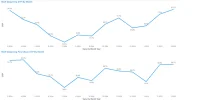
Departure on-time performance depends on several factors including weather, airfield operations, and technical issues. Monthly performance for the past financial year across all flight types are outlined below:
 6. OPERATIONAL ENVIRONMENT – ROUTES AND SERVICES UPDATE
FY25 Update:
• In FY25, April 2024 - March 2025, Manchester Airport delivered 31.1m passengers.
• This was another record breaking year for the airport with passenger numbers increasing by +2.4m versus the previous year.
Quarter 4 Update:
• During the 4th Quarter (January – March 2025), 6.2m passengers travelled through Manchester Airport.
• The delivery of 6.2m passengers was an increase of 6% on 2024 levels (+8% in January, +6% in February and +4% in March).
• Year-on-year passenger growth continues to be driven by low-cost carriers. Ryanair (+13%) and easyJet’s (+5%) collective growth added +253k passengers versus the previous year.
• In addition to the growth above, there was also significant YoY growth from numerous other carriers including Hainan Airlines (+134%), Etihad (+38%), Cathay Pacific (+31%), Saudia (+29%), Gulf Air (+26%) and the Aer Lingus Long-haul service to North America (+12%), amongst many others.
There have been numerous developments to Manchester Airport’s network in the Quarter, including:
• IndiGo have announced they are entering the European market in Summer 25 and Manchester-India will be one of their launch routes. It is fantastic to have this strategic unserved market secured and is expected to launch this summer.
• Etihad increasing their schedule at Manchester to 10 x weekly, with the carrier planning to further increase their schedule to double-daily in Summer 25.
• Iberia increasing the Manchester - Madrid service to daily, allowing for improved connectivity to their onwards network in South America.
• Juneyao confirming they would increase frequency to a daily Manchester – Shanghai service in Summer 25 due to strong demand on the route. With Hainan Airlines operating their Manchester –Beijing flight daily and Cathay Pacific their Hong Kong flight daily, this means that Manchester will have up to 3 x daily flights to China and Hong in Summer 25.
• Loganair announcing they will launch a new Exeter and Southampton service from October 25, providing crucial domestic connectivity to Manchester Airport and which will also help feed the airport's long-haul network.
• Ethiopian Airlines announcing they would increase their Manchester – Addis Ababa service from 5 x weekly to daily from July 25.
• Saudia announced they would increase their Manchester – Jeddah service to daily in Summer 25.
• Turkish Airlines going on sale with a 28 x weekly program in Summer 25, the carrier’s largest ever schedule from Manchester Airport.
7. CAR PARKING & SURFACE ACCESS
• Landside Operations: Call volumes have remained constant compared to the same period last year and traffic volumes have been slightly higher based on the same period last year. M&G volumes have continued to exceed budgeted forecasts in the final quarter of FY25. The landside control room assisted 265,589 customers via our car park/forecourt intercoms during Jan 25 - Mar 25, up from 242,543 for the same period in 2024. Landside NPS continues to remain high when compared across the group, currently running at 52.4%, up from 47.5% on the previous quarter, against a target of 41.0%. Barrierless forecourts went live on Terminal 2 and Station on Wednesday 26th March 2025, and for Terminal 1 and Terminal 3 on Wednesday 2nd April 2025.
• Customer Transport: Customer Transport delivered average airfield coaching SLA performance across the quarter of 90% with performance affected by substantial adverse weather events in January. Landside services continued to perform strongly, supporting a robust and above target NPS performance throughout the quarter. JetParks 1 opened earlier than planned to support passenger growth heading into the next quarter. Recruitment activity Jan-Mar was elevated to support the growth in both airfield coaching and landside bussing, with over 50 external and 30 internal offers made in the period.
• Car Parking: Car park occupancy averaged 99% throughout the quarter, across all self-park and Meet & Greet products, with both self-park and Meet & Greet continuing to perform very well. NPS has been sustained at record high levels, averaging 68 vs. target 41 and in some products continued to perform as well as 70. Capacity balancing continued across the estate to mitigate the space loss of T1MSCP. Cloud migration for ParkIT, as referenced in the previous quarter was completed for all products, improving the reliability of the system and offering service enhancements from a reporting perspective.
• Manchester Airport Ground Transport Group: This group of internal stakeholders continues to meet to discuss how we can work collaboratively to enhance ground transport/surface access to the airport site. A pipeline of potential schemes which can be considered forsupport from the sustainable transport fund is being developed.
• Bee Network Round Table Discussions: A roundtable discussion was held at Manchester Airport with Mayor Andy Burnham on the 26th March. This event offered an opportunity to showcase the recent upgrades made at the Ground Transport Interchange. The meeting sought to promote the benefits of the Bee Network and to explore collaboratively the process of planning for future enhancement/improvements to the Ground Transport Interchange.
• Ground Transport Interchange Master Planning Activity: The GTI handles some 4 million passenger movements annually, and with the airport’s forecast growth, we are keen to increase mode-share and enhance the transport connections to those which might be expected at a major international airport.
The GTI opened in 2004, and other than the addition of two additional rail platforms and Metrolink, the overall facility has remained largely untouched. Work is underway on the overall scope of a master plan for the GTI, covering not just the facility requirements and opportunities but the wider surface access strategy for Manchester, and the fit with the wider Manchester master plan. The first iteration details both a strategic commitment and expectation that through the development of rail, coach, tram, and bus services there is an opportunity to increase the percentage of passenger trips to and from the airport that use public transport
• Collaboration with Flixbus: Flix Bus has recently committed to new coach services at the airport. These new services will strengthen the coach offer to Liverpool, while opening up new routes to Hull and London (via Birmingham) for passengers.
• Platform Lengthening Scheme: We are continuing to support Network Rail with the preparation of a business case (for submission to the Department of Transport), which seeks funding to lengthen the platforms at Manchester Airport Station. If funding is approved, it could see the platforms lengthened (by 2030), which will allow us to receive longer passenger trains, hence increasing rail passenger capacity. Site visits have been facilitated to explore the feasibility of works and we expect these to continue over coming months.
8. MOBILITY SERVICES
CAA rating: We have seen extremely strong performance across all our key measures for Special Assistance services. Our key performance measures for the Civil Aviation Authority to assist pre-booked arriving passengers within 20 minutes, and non-booked arriving passengers within 45 minutes, are at 99.64% and 99.99% respectively for the financial year ending in March, this surpasses the threshold for a ‘Very Good’ rating from the CAA, and is despite the fact that every month in 2024/5 has seen growth for PRM’s at Manchester, with our busiest ever months in September and October. PRM satisfaction ended FY25 at 4.17/5, which again exceeds target of 4/5 for a ‘Very Good’ rating.
Passenger experience: Strong performance in all our key measures has been seen throughout the year to date, customer feedback is also performing strongly with satisfaction scores exceeding CAA target for a ‘Very Good’ rating and a year-on-year reduction in the number of complaints.
12. FUTURE AIRSPACE The ERG323 North West Transit Corridor (NWTC)
The Manchester Low Level Route (MLLR) evolved into the North West Transit Corridor (NWTC) on Thursday 20th February 2025. The NWTC is classified as ‘Class G’ (was Class D), has a ceiling of 1,500ft (was 1,300ft) and is now wider (towards Manchester Airport). On Monday 10th March, in collaboration with NATS, CAA and Barton Aerodrome, MAG hosted an aviation safety evening at the Runway Visitor Park. The event attracted more than 75 pilots from Barton Aerodrome, Blackpool Airport, Liverpool John Lennon Airport, Teesside International Airport and Clacton Airport. Presentations were made on:
• Airspace infringement prevention, outlining the tools and awareness needed to be used by all and
• A particular focus on local infringement hotspots
• The new NWTC emphasising local landmarks useful for visual reference in establishing the parameters of the Corridor.
The evening concluded with Q&A Panel addressing questions that had been posed through the evening. By working together with our NATS, CAA and Barton Aerodrome colleagues, we delivered an informative event that highlighted the parameters of the NWTC and promoted aviation safety for the General Aviation community.
Wider Airspace Modernisation update
In the Scottish Terminal Manoeuvring Area (TMA) Glasgow Airport has passed through the Stage 3 Gateway (joining NATS EnRoute -NERL) after submitting some minor clarifications to the CAA. Edinburgh Airport postponed the submission of their second attempt at Stage 3 (should have been February) with a new date yet to be identified. Glasgow Airport and NERL will need to pause and wait for Edinburgh to catch them up.
In the Manchester TMA, Leeds Bradford Airport have again postponed the submission their third attempt at the Stage 2 Gateway (should have been April) with a new date yet to be identified. London Gatwick Airport (having postponed their Stage 3 submission for London Airport South (LAS) pending further options analysis and environmental assessment work) have agreed a new Stage 3 Gateway of 26th September 2025. Aberdeen Airport has now progressed to Stage 5 ‘Decide’ with their Gateway due 27th June 2025.
The aspiration of London Heathrow Airport for a third runway and London Gatwick Airport to convert their standby runway for routine use have further confused timelines for the London TMA whilst the results of the joint CAA/DfT UK Airspace Design Service (UKADS) consultation are compiled.
Reduction for the need for Non-Standard Departures (NSDs)
Non-Standard Departures are special instructions to fly outside of the tolerances of the Preferred Noise Routes and historically have been required:
• To maintain separation from aircraft such as Police or Air Ambulance.
• To direct aircraft away from poor weather.
• In the event of equipment outage of a ground based navigational aid (to provide the initial routing and separation).
Aircraft following NSDs fly outside the areas one would usually expect to experience aircraft overflight. As such NSDs can cause disturbance to those communities close to Manchester Airport. As of 10th February 2025, should a ground based navigational aid be unserviceable then it will be assumed the aircraft can still fly the route, using an overlay, unless the pilot states otherwise. This means the aircraft will fly the usual departure route and not be issued a non-standard departure instruction. This is a significant step forward for Manchester Airport that will benefit our neighbouring communities and airlines. The change will enable NATS Air Traffic Controllers to continue to safely and efficiently depart aircraft while causing the least disturbance possible through current navigational techniques.
The Manchester Airport Future Airspace project (ACP-2019-23)
As members are aware, in the Manchester Terminal Manoeuvring Area (TMA) there are Airspace Change Processes underway (between ground and 7,000ft) at Manchester (MAN), East Midlands (EMA), Liverpool John Lennon (LPL) and Leeds Bradford (LBA) Airports. NATS En Route Ltd (NERL) are undertaking works above 7,000ft.
As previously reported although Manchester/East Midlands Airports have made a great deal of progress on the Stage 3 design and preparation for evaluation requirements other airports in the Manchester TMA cluster have not progressed at the same pace. The Airspace Change Organising Group (ACOG) are producing a revised programme for the cluster sponsors to feed into and then agree. Of course, once we have an agreed new gateway date, we will communicate it to Members.
We continue to make steady progress in developing and appraising our designs and further refine our consultation strategy. In January we met with our Stakeholder Reference Group and have another meeting planned for June to further develop/inform our Consultation Strategy. Over the coming months we will also be intensifying our communications in order to ‘prepare the ground’ for consultation.
Projects to remove reliance on the MCT DVOR
As previously reported, the existing departure and arrival procedures are dependent upon national assets (provided by NATS En Route Ltd) scheduled to be removed from service on 1st January 2026. The Manchester Airport Future Airspace project (ACP-2019-23) will provide the long-term solution, entirely replacing dependency on ground based navigational aids with Satellite navigation. Two projects will ‘bridge’ the gap between removal of the ground based navigational aids and the delivery ACP-2019-23:
• ACP-2024-002 Contingency RNP approaches for Runway 23R, Runway 05L & Runway 05R.
• ACP-2024-007 RNAV Substitution of Eligible Conventional Procedures.
We made our final submissions (to the CAA) for both ACP-2024-002 and ACP-2024-007 in 2024. Unfortunately, the CAA are no longer able to make their assessments according to the timescales that they had originally agreed. We are now working with our CAA colleagues to target the resources they have available on removing dependency on the MCT DVOR before the end of 2025. The MCT DME will continue to be available into 2026 and so these dependencies are not so urgent.